 Third Act Review
Structure · pacing · plot
Third Act Review
Structure · pacing · plot
A quarterly of long-form criticism about how story-driven games are built, and about the point in the second half where a plot either holds or stops holding.
Third Act Review
Structure · pacing · plot
A quarterly of long-form criticism about how story-driven games are built, and about the point in the second half where a plot either holds or stops holding.
Horror games are discussed in terms of what happens in them. Measuring the gaps instead, across five games, suggests the opposite emphasis: the interruptions are nearly interchangeable, and what separates the effective games is how long the quiet lasts and what it makes you do while it lasts.
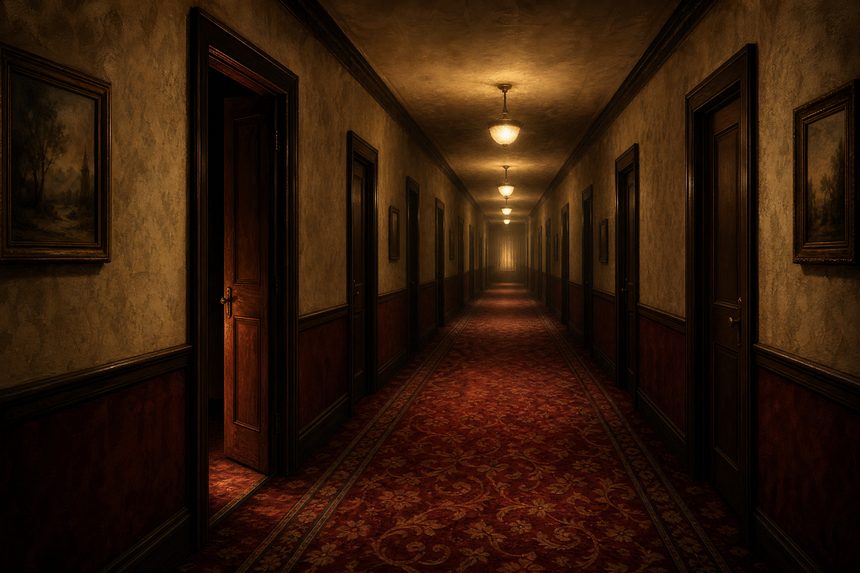
I began these notes intending to write about scares and finished writing about walking. Across five games I timed the interval between what I recorded as threatening events, meaning anything the game intended the player to read as danger, and the distribution of those intervals turned out to describe the games better than any description of the events themselves.
The events, once catalogued, are remarkably similar between titles. A sound with no visible source. A figure at the far end of a space. A door that was closed. An object that has moved. Five games, four categories, and almost no variation in execution. If the events were doing the work, these games would be much more alike than they feel.
Here is what the timing showed. The two games I found most effective maintained long intervals, between four and nine minutes, and varied them unpredictably within that band. The two least effective ran intervals of ninety seconds to two minutes with very little variation. The fifth sat between and is more interesting than either.
Short, regular intervals produce a rhythm, and a rhythm is a form of safety. Once I could feel the metre of a game, I stopped being apprehensive and started waiting, which is a completely different state and a much less useful one.
| Interval pattern | Games | State produced |
|---|---|---|
| 4 to 9 minutes, unpredictable | 2 | Sustained apprehension |
| 90 seconds to 2 minutes, regular | 2 | Waiting; rhythm becomes safety |
| Long intervals, but signposted | 1 | Apprehension undermined by tells |
A rhythm you can feel is a rhythm you can trust, and trust is the opposite of what these games want.
Long intervals only work if the quiet has something to occupy it, which is where the two effective games differ from the one that signposts.
Both give the player a task during the quiet: an inventory to manage, a route to remember, a mechanism to work out. The task is absorbing enough to occupy attention and not so absorbing that it removes awareness of the space. The player is doing something with divided attention, which is the condition under which an interruption actually interrupts.
The game that signposts has the intervals right and the tasks wrong. Its quiet stretches are empty walking, so the player's attention has nowhere to go except forward, watching for the event. And a player watching for an event will find the tell, because there is always a tell: a music cue, a doorway framed too carefully, a corridor that suddenly has no clutter in it.
From the two successful games I would describe the ideal quiet stretch as having three parts, though neither game presents it that way and I may be imposing an order that is not there.
It opens with relief, in which the previous event is understood to be over. It continues with occupation, in which a task takes the foreground. And it ends with an unresolved detail: something noticed and not explained, ten or fifteen seconds before the next event, that gives the interruption somewhere to attach.
That last element is the part the unsuccessful games omit. Their events arrive without preparation, which sounds like it should be more frightening and is in fact less, because an event with no antecedent is only a surprise. It cannot be a confirmation of something the player had begun to suspect.
| Element of the interval | Function | Present in |
|---|---|---|
| Relief | Establishes that the previous event closed | 4 of 5 |
| Occupation | Divides attention; task in the foreground | 2 of 5 |
| Unresolved detail | Gives the next event something to confirm | 2 of 5 |
A related technique appears in four of the five and works every time it is used, which is unusual enough to note. Late in the game, a space the player knows well is wrecked. Not replaced, wrecked: the same geometry, damaged, relit, with the route through it altered. It costs a fraction of a new area and it produces an effect no new area can, because the comparison is supplied by the player at no charge.
In the one game where it did not land, the wrecked space was one the player had passed through twice. The technique depends entirely on familiarity, and familiarity requires either duration or repetition. Two visits is not enough, and this is a straightforward scheduling matter: the space to be wrecked has to be a space the game has already insisted upon.
Time the gaps rather than the events. If the intervals are short and regular, the game has a metre and the player will find it. If they are long and empty, the player will hunt for tells and will succeed. Long, occupied, and ending on something unexplained is the arrangement that keeps working, and it is a matter of level scripting rather than of what appears at the end of the corridor.
The interruptions in horror games are nearly interchangeable, so the design problem is the quiet: long enough to be uncomfortable, occupied enough to divide attention, and ending on a detail the next event can confirm.